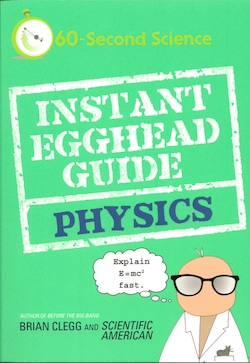
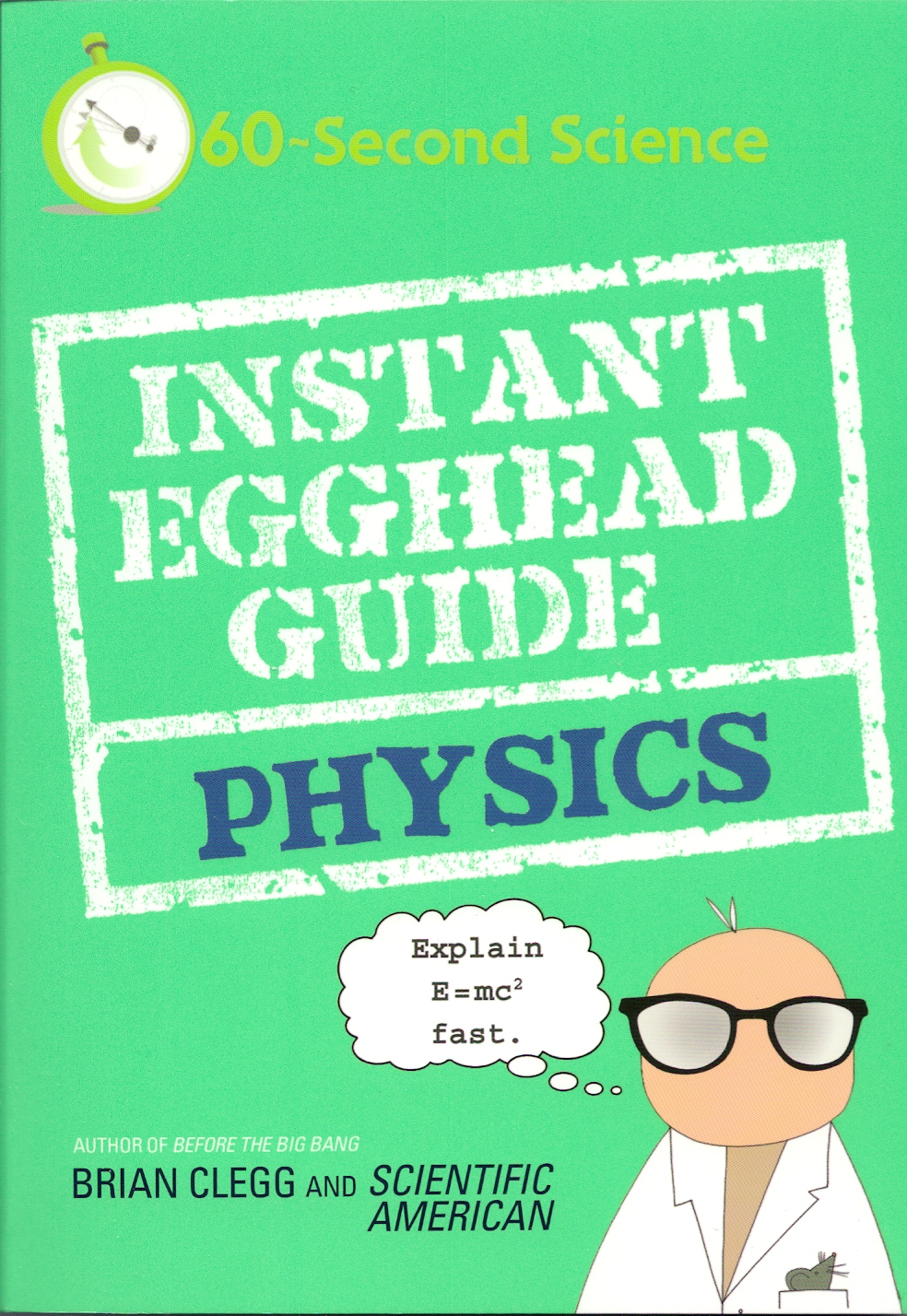
Instant Egghead Physics
It’ll help you get a few more of the jokes on The Big Bang Theory.
Brian Clegg
Physics, the topic of this book, is the fundamental science.
The great physicist Ernest Rutherford once said “All science is either physics or stamp collecting.” He meant that most other science at the time was about collecting and categorizing information. Physics explained how the universe works. And that’s exciting stuff.
Instead of taking the traditional approach of starting with 19th century science and bolting on what has since replaced it, the Instant Egghead Guide to Physics plunges in with quantum theory, relativity and more - making these fundamentals of physics easy to grasp, and building a modern picture of the workings of the universe on them.
The 100 topics are divided into sections on Matter, Quantum Theory, Light, Relativity, Forces and Energy. Each short, readable article finishes up with cocktail party tidbits. For example:
• About 50 trillion neutrinos from the Sun shoot through your body every second.
• Because all solid matter was produced in early stars and stellar explosions, Joni Mitchell got it right in her 1960s song “Woodstock” - we are stardust.
• If you flew towards a black hole, the difference in gravitational pull between your feet and your head would stretch you out long and thin like a piece of spaghetti.
• Our eyes are so sensitive we can see a candle flame ten miles away on a truly dark night.
If you’d like a signed copy - it makes a great gift - purchase direct below when available. If you want a personalised inscription, just drop Brian an email at the same time with the details.
Paperback
Using these links earns us commission at no cost to you
Reviews
You’ve gotta love a book that follows “Chapter One: Matter” with “Chapter Two: Quantum Theory.” The Instant Egghead Guide: Physics by Brian Clegg and Scientific American does just that, and then continues on through chapters about Light, Relativity, Forces and Energy. The cover calls it “60-Second Science,” and each subject is a two-page spread that takes about a minute or two to read. The chapter about matter, for instance, is broken down into subjects such as atomic structure, various phases of matter, string theory and the big bang.
Each subject has three short sections: The Basics, On the Frontier, and Cocktail Party Tidbits. The Basics is just that: a very simple, straightforward explanation of the topic at hand. On the Frontier is usually a little extra information, sometimes but not always about the current state of knowledge on a subject, or perhaps an example of how this bit of information is used in practical applications. Cocktail Party Tidbits is the fun stuff: little trivia about Einstein or a snarky remark Feynman once made.,,
Those of you who are physics geeks most likely won’t learn anything new from this book (except some nifty trivia that will come in handy next time you’re at a cocktail party, whatever that is). But if you need a refresher course—if, say, your high schooler starts asking you about things you haven’t studied since you were in high school—this is a handy book to have around. With a little over 100 topics, you can spend just a few minutes a day and get a pretty good overview of physics in a short period of time. At the very least, it’ll help you get a few more of the jokes on The Big Bang Theory. Wired.com
Links to purchase books earn us commission at no cost to you

To keep up to date via Facebook, click Follow Page to follow the Brian Clegg page: